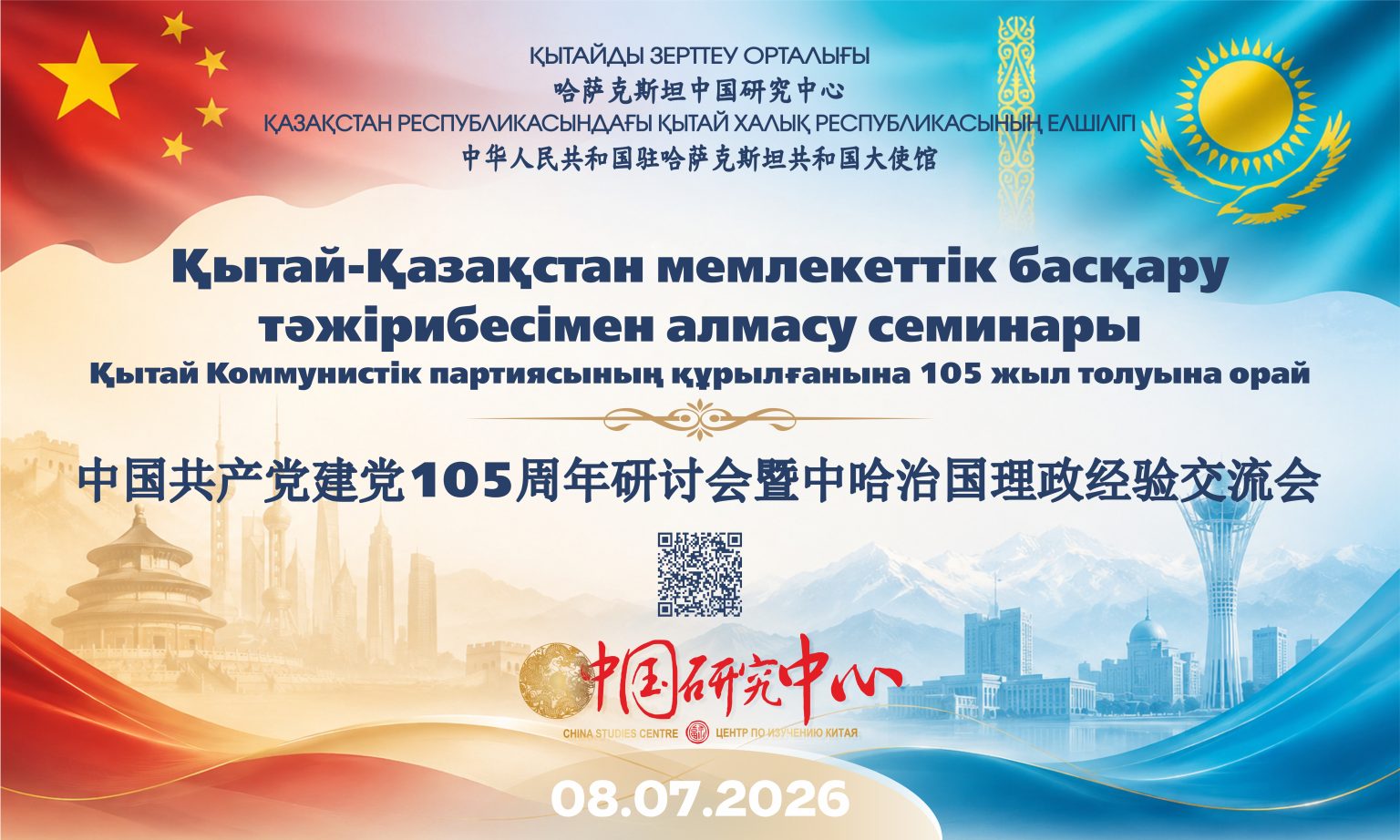
The China-Kazakhstan Seminar on Exchange of Experience in State Governance, dedicated to the 105th anniversary of the founding of the Communist Party of China, was held in Astana. The event was organized by the China Studies Center jointly with the Embassy of the People’s Republic of China in the Republic of Kazakhstan and brought together representatives of the diplomatic corps, government agencies, political parties, expert and analytical institutions, business circles, and the media.
Opening the seminar, Gulnar Shaimergenova, Director of the China Studies Center, emphasized that the event was intended to serve as a meaningful platform for professional dialogue on development, institutions, strategic planning, and long-term models of state governance. She noted that China’s experience is of particular interest from the perspective of analyzing mechanisms for coordinating development, institutional resilience, and the implementation of long-term goals, while for Kazakhstan the key value lies not in copying models, but in gaining a deep understanding of the logic of its partner and strengthening the expert dimension of bilateral cooperation. According to her, against the backdrop of Kazakhstan-China relations reaching the level of a permanent comprehensive strategic partnership, analytical exchange, research cooperation, and the development of the intellectual foundation of bilateral dialogue are becoming increasingly important.
Han Chunlin, Ambassador Extraordinary and Plenipotentiary of the People’s Republic of China to the Republic of Kazakhstan, delivered welcoming remarks. He noted that over the past 105 years, the CPC has gone from being a small political force to the world’s largest ruling party, successfully ensuring the country’s historic transformation, accelerated modernization, and sustainable development. The Ambassador emphasized that China’s experience is based on long-term strategic thinking, adherence to the course of reform and innovation, reliance on the interests of the people, as well as the ability for internal renewal and institutional improvement. It was especially emphasized that Kazakhstan and China are good neighbors, reliable partners, and true friends, while the exchange of experience in the field of state governance and inter-party cooperation serves as an important tool for deepening the bilateral strategic partnership.
Daniya Yespayeva, Chairwoman of the Democratic Party of Kazakhstan “Ak Zhol”, emphasized in her speech that China’s achievements in state governance, the economy, science, and technology command well-deserved respect throughout the world, while the Belt and Road Initiative and the concept of a Community with a Shared Future for Mankind have become significant factors in regional and international development. According to her, China remains not only a good neighbor for Kazakhstan, but also a strategic partner with which the country is linked by relations of permanent comprehensive strategic partnership based on trust and mutual respect. She also noted that inter-party cooperation with the CPC, which has been developing for 14 years, is an important instrument of people-to-people diplomacy, exchange of governance practices, and the strengthening of investment, cultural, and humanitarian ties.
Nursultan Shokanov, Chairman of the People’s Party of Kazakhstan, noted in his speech that Chinese modernization is of great interest to political and expert circles, as it demonstrates the close connection between effective state governance and improving the well-being of citizens. The speaker emphasized that the long-standing ties between the People’s Party of Kazakhstan and the CPC have become an important part of inter-party trust and an additional pillar of the bilateral strategic partnership. He separately drew attention to the practical significance of China’s experience, referring to his own impressions from a visit to the PRC, where he clearly saw how long-term state strategies are implemented at the regional and local levels. As promising areas of cooperation, he identified the expansion of experience-sharing in social and regional policy, the development of contacts between analytical centers and youth structures, as well as the strengthening of cooperation through women’s organizations.
Nurbek Matzhani, a member of the Political Council of the ADILET Party, noted in his speech that over 105 years the CPC has played a key role in transforming China into one of the world’s leading powers, while its experience in strategic planning and reform has attracted broad interest in many countries. He emphasized that Kazakhstan-China relations are developing on a solid foundation of trust, mutual respect, and equal cooperation, entering a new “golden 30 years.” The speaker paid particular attention to reforms within Kazakhstan itself, linking the theme of the seminar with the country’s ongoing political modernization, the adoption of the new Constitution, and the formation of an updated model of state structure.
Zhanargul Alzhanova, Deputy Chair of the Committee for Civil Society Affairs of the Ministry of Culture and Information of the Republic of Kazakhstan, emphasized that the current stage of Kazakhstan’s development is characterized by large-scale political and institutional modernization aimed at forming a more open, effective, and accountable system of state governance. Her speech focused on the constitutional transformations of 2026, the renewal of the architecture of state power, the establishment of the Kurultai, and the constitutional consolidation of the institution of the Qazaqstan Khalyq Kenesi as an important mechanism of public participation. The speaker separately noted the importance of the concept of the “listening state,” the growth of civic engagement, and digital transformation, which enhance transparency, improve the quality of public services, and expand feedback between the state and society.
In his report, Amangeldy Tazhenov, Deputy Chairman of the Management Board of the Institute for Foreign Policy Studies under the Ministry of Foreign Affairs of the Republic of Kazakhstan, noted that relations between Kazakhstan and China continue to maintain a steady upward dynamic and are currently characterized by a high level of political dialogue, intensive high-level contacts, and effective institutional coordination. In his assessment, bilateral cooperation demonstrates an all-weather character and continues to develop steadily even amid global instability. The speaker particularly highlighted the trade and economic dimension of the partnership, the growth of trade turnover, the expansion of China’s investment presence in Kazakhstan, the development of transport and logistics connectivity, and the strengthening role of the Middle Corridor. He also emphasized that the digital economy, artificial intelligence, green technologies, and humanitarian exchanges are taking an increasingly important place on the agenda.
Zhanar Sankhayeva, Head of the Department of Political Studies at the Kazakhstan Institute for Strategic Studies under the President of the Republic of Kazakhstan, devoted her speech to the transition from digitalization to intelligent state governance. She noted that China’s experience demonstrates the effectiveness of long-term planning and the mechanism of pilot projects followed by the scaling of successful solutions to the national level. Presenting Kazakhstan’s practice, the speaker highlighted the development of data-driven governance, the use of the Smart Data Ukimet platform, the “Digital Family Map”, and the introduction of e-Otinish AI as examples of the transition to a proactive and intelligent model of governance. According to her, it is precisely such tools that are shaping the modern architecture of a new-generation state apparatus.
Serik Korzhumbayev, Editor-in-Chief of the newspaper Delovoy Kazakhstan, emphasized in his speech that the study of modern China has not abstract but direct practical significance for Kazakhstan, as it is linked to key processes of regional development and Eurasian connectivity. He noted that the main distinctive feature of China’s experience lies in its ability to think strategically and build development decades ahead, linking infrastructure, education, technology, ecology, and regional policy into a single system. According to him, the media, expert institutions, research centers, and humanitarian ties play a special role in further deepening Kazakhstan-China cooperation, creating an atmosphere of trust and sustainable mutual understanding.
The block of speeches was concluded by Talgat Ibadilda, Director of the CNPC Kazakhstan Representative Office in Astana. He noted that China’s experience clearly demonstrates the importance of consistent state governance, long-term planning, reforms, and the development of human capital as the foundation of sustainable growth. The speaker emphasized that for Kazakhstan, China’s experience is of significant practical interest, especially in the context of active cooperation between the two countries in the fields of energy, transport, industry, digitalization, science, education, and investment. According to him, holding such expert seminars contributes to strengthening mutual understanding between the professional communities of the two countries and creates an additional basis for the further expansion of the Kazakhstan-China strategic partnership.
Following the event, the participants confirmed their strong interest in continuing meaningful exchange of experience in the fields of state governance, institutional development, strategic planning, and digital transformation. It was noted that the development of such expert dialogue meets the objectives of further strengthening Kazakhstan-China good-neighborly relations, expanding practical cooperation, and filling bilateral interaction with new substance.
Durning the 2026 Shanghai Cooperation Organization Media and Think Tank Summit, Xinhua Institute, a think tank affiliated with Xinhua News Agency, released "Upholding Fairness and Justice and Improvi
 English
 注册
注册


 首页
首页
 动态信息
动态信息
 交流活动
交流活动
 研究成果
研究成果
 成员信息
成员信息
 联系我们
联系我们