
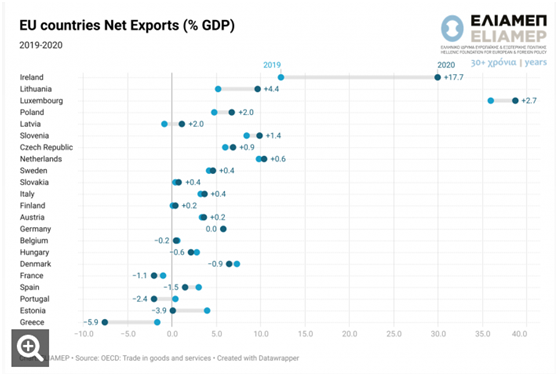
In 2020, trade in the Member States of the European Union (EU) was severely affected by the pandemic, recording significant declines in both exports (-9.4%) and imports (-11.6%) compared to the previous year. As a result, the total volume of trade was significantly affected by the coronavirus crisis. Beyond this largely expected development, is it interesting to see how the trade balances of the EU Member States evolved during the pandemic.
In order to answer this question, we obtained the latest available import and export data for 21 EU Member States from the OECD database. As shown in the graph above, net exports, i.e., the difference between exports and imports, have varied considerably between Member States.
The most significant change concerns Ireland, which has seen a marked increase (17.7%) in its net exports from 2019 to 2020. The reason is that the country is a global hub for pharmaceutical production and medical technologies, with many of the world’s top companies in these sectors having a presence there, including, among others, Pfizer, Johnson & Johnson, Roche, Novartis and AbbVie.
On the contrary, countries such as Spain (-1.5%) Portugal (-2.4%) and especially Greece (-5.9%), recorded a decrease in their net exports, apparently due to the negative impact of the pandemic on tourism (the travel expenses of visitors are considered as exports of tourist services for these countries), which is extremely important for their economies.
以“聚媒智 启新程——携手构建中阿命运共同体”为主题的“全球南方”媒体智库高端论坛中阿伙伴大会12日在位于埃及首都开罗的阿拉伯国家联盟(阿盟)总部开幕,来自中国和阿拉伯国家约110家媒体、智库、政府机构、企业及国际和地...
 English
 注册
注册


 首页
首页
 动态信息
动态信息
 交流活动
交流活动
 研究成果
研究成果
 成员信息
成员信息
 联系我们
联系我们