
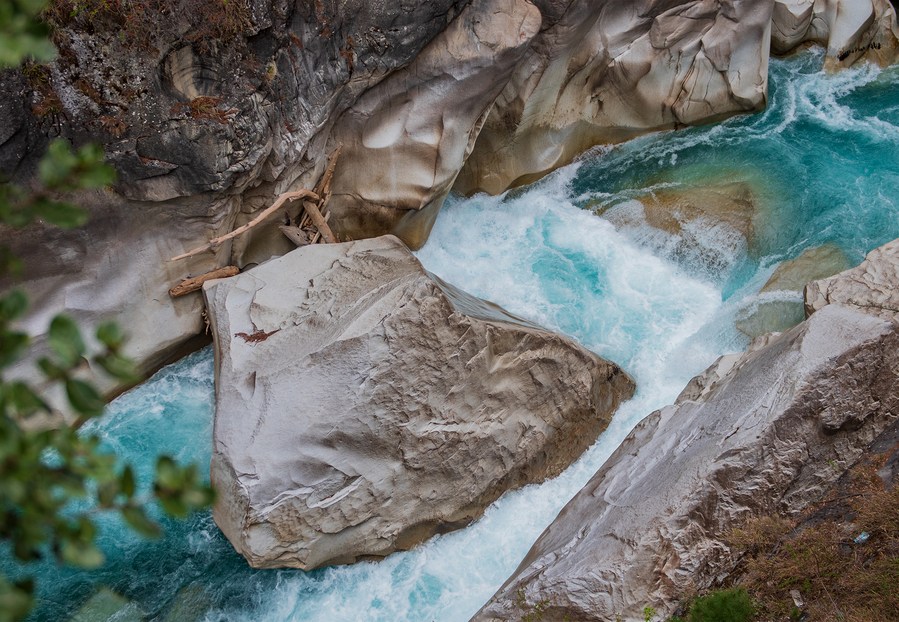
Aerial photo taken on April 6, 2020 shows a view of Zayu River in Zayu County of Nyingchi City, southwest China's Tibet Autonomous Region. (Xinhua/Hou Jie)
BEIJING, Aug. 27 (Xinhua) -- Geologists from China and Myanmar have found new seismic evidence to support a model that explains how the Indian subcontinent drifted northward anomalously fast and collided with Asia in ancient times.
The study, published on Saturday in the journal Science Advances, reveals that closure of the Neo-Tethys Ocean in the Mesozoic Era and the subsequent formation of the Qinghai-Tibet Plateau were likely caused by double subduction, a geodynamic process in which two plates following each other are synchronously subducted.
The researchers from the Chinese Academy of Sciences, the Myanmar Geoscience Society, Yangon University and Dagon University conducted high-resolution investigation of upper mantle structures beneath Myanmar.
The Myanmar region occupies the eastern end of the Indian-Asian collisional system. Due to less reworking from continental collision, it is an ideal place to probe possible slab remnants of double subduction, according to the study.
The research reveals, for the first time, two subparallel subducted slabs preserved intact in the present upper mantle beneath the Neo-Tethyan tectonic regime, supporting the double subduction model of the Neo-Tethys Ocean.
Durning the 2026 Shanghai Cooperation Organization Media and Think Tank Summit, Xinhua Institute, a think tank affiliated with Xinhua News Agency, released "Upholding Fairness and Justice and Improvi
 English
 注册
注册


 首页
首页
 动态信息
动态信息
 交流活动
交流活动
 研究成果
研究成果
 成员信息
成员信息
 联系我们
联系我们